Supplement Ingredient Sourcing: The 2026 Guide to Quality & Compliance

In an era of global instability and stricter FDA scrutiny under FSMA 204, your supplement ingredient sourcing strategy is either your biggest asset or your biggest liability. Gone are the days when procurement teams could prioritize price above all else. Today, the supplement brands that thrive are the ones that treat sourcing as a compliance function, not just a cost center.
The shift is significant. Traceability has moved from a “nice-to-have” feature to an operational requirement. Regulators, retailers, and consumers now expect documented proof of where every ingredient originated, how it was tested, and who verified its authenticity. For brand owners and operations directors, this means rethinking how you evaluate suppliers, manufacturers, and the documentation that connects them.
| What is Supplement Ingredient Sourcing? The process of procuring raw vitamins, minerals, and botanicals while verifying their identity, potency, and safety under 21 CFR Part 111 regulations. |
This guide provides the risk management framework you need to audit your current supply chain and make informed decisions about your manufacturing partnerships.
The Hidden Risks in Global Supplement Ingredient Sourcing
Most articles on this topic read like geography lessons, listing countries where popular ingredients grow. That information is helpful, but it misses the point. The real question is not where your turmeric or ashwagandha comes from. The real question is whether you can prove its identity, purity, and chain of custody if the FDA shows up tomorrow.
Documentation Risk by Supply Chain Structure
The risk in global sourcing is not geography. It is the number of intermediaries between the original producer and your manufacturing facility. Each handoff in the supply chain creates an opportunity for documentation gaps, substitution, or contamination. A botanical grown in India and sold directly by the cultivator carries different risks than the same botanical passing through three trading companies before reaching your manufacturer.
| Supply Chain Model | Documentation Risk | Verification Complexity | Typical COA Reliability |
| Direct from Producer | Lower | Simpler chain of custody | Higher (source-verified) |
| Single Distributor | Moderate | One intermediary to audit | Moderate (requires validation) |
| Multiple Trading Companies | Higher | Complex paper trail | Lower (often copied/unverified) |
| Broker Networks | Highest | Difficult to trace origin | Lowest (origin often unclear) |
The number of intermediaries in your supply chain directly affects your ability to verify ingredient authenticity and maintain compliant documentation.
The Verification Gap
The most common mistake brand owners make is assuming their contract manufacturer handles all sourcing verification. Many manufacturers do perform incoming material testing. However, the depth of that testing varies dramatically. Some facilities run full identity and potency panels on every lot. Others rely on supplier-provided Certificates of Analysis without independent verification.
This gap becomes a liability when regulators request records. Under 21 CFR Part 111, you are responsible for establishing component specifications and verifying that incoming materials meet them. If your manufacturer cannot produce validated test results, the compliance burden falls on your brand.
How to Source Ingredients for Supplements: A Vetting Checklist

Learning how to source ingredients for supplements requires a systematic approach to documentation review. You do not need a chemistry degree to evaluate your supply chain, but you do need to know which questions to ask and which documents to request.
Demand the Manufacturer’s COA
A Certificate of Analysis is only as reliable as its source. Trading companies routinely provide COAs that they received from their own suppliers, sometimes with minimal verification. This chain of documents can stretch across multiple intermediaries, each copying the previous one.
The document you need comes from the facility that actually produced or extracted the ingredient. Look for:
- Facility name and address matching the declared origin
- Specific lot numbers tied to your shipment
- Method references for each test performed
- Signatures from qualified laboratory personnel
A generic trader COA without method references is a red flag. A validated manufacturer COA with complete test documentation provides the verification you need.

Identity Testing is Non-Negotiable
If your manufacturer does not perform identity testing on every incoming drum, they are making assumptions about what they received. Two analytical methods have become industry standards for botanical verification:
FTIR (Fourier Transform Infrared Spectroscopy): This technique creates a molecular fingerprint of the material. Authentic ingredients produce consistent spectral patterns that can be matched against reference standards. Adulterated or substituted materials show different signatures.
HPTLC (High-Performance Thin Layer Chromatography): This method separates plant compounds visually, allowing technicians to compare unknown samples against verified reference materials. It is particularly effective for detecting botanical substitution.
Ask your manufacturer which identity tests they perform and request sample reports. Facilities with robust quality standards will provide this documentation readily.
Watch for the “Fairy Dusting” Trap
Fairy dusting refers to the practice of adding trace amounts of expensive ingredients to formulas while bulking them with cheap fillers. The label may list impressive extracts, but the actual product contains mostly maltodextrin or rice flour.
This problem extends to raw materials. Some suppliers sell “extracts” that are heavily diluted with carrier materials. The COA shows the correct active compound, but the concentration is far below what a legitimate extract would contain. Request standardization data and compare it against industry benchmarks for the ingredient category.
Best Supplements Made with Responsibly Sourced Ingredients
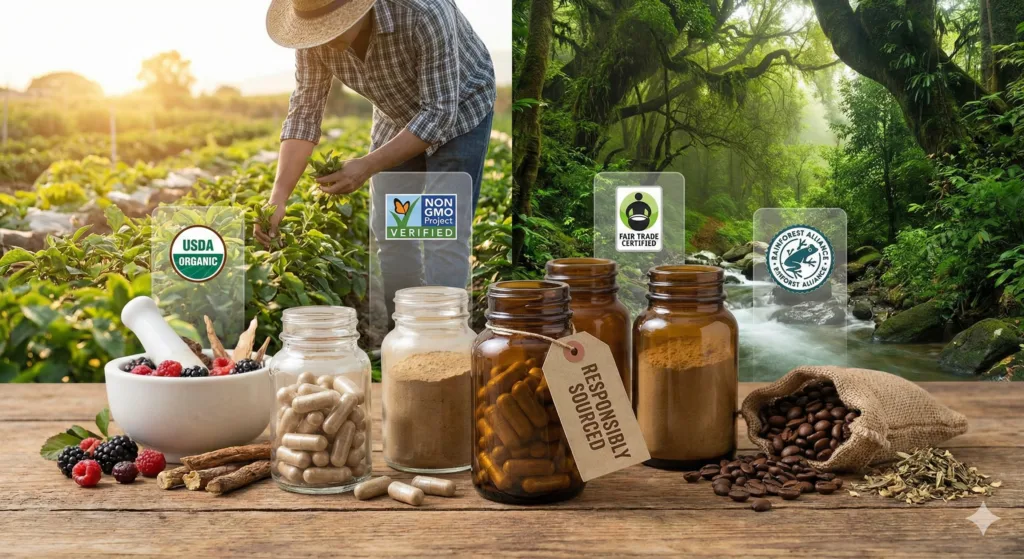
The best supplements made with responsibly sourced ingredients share common characteristics that go beyond marketing claims. Responsible sourcing encompasses traceability, ethical harvesting practices, and environmental sustainability. For brand owners, these factors increasingly influence retail placement and consumer purchasing decisions.
What Responsible Sourcing Looks Like
Responsible sourcing programs typically include supplier audits, sustainability certifications, and documented chain of custody records. Third-party certifications provide independent verification that sourcing practices meet established standards.
Common certifications to look for include:
- USDA Organic – Verifies organic farming practices for botanical ingredients
- Non-GMO Project Verified – Confirms absence of genetically modified organisms
- Fair Trade Certified – Addresses ethical labor practices in sourcing regions
- Rainforest Alliance – Focuses on environmental sustainability
These certifications may add cost to your raw materials, but they also provide marketing differentiation and potentially reduce compliance risk. Retailers increasingly require sustainability documentation for shelf placement, making responsible sourcing a business consideration as well as an ethical one.
Partnering with the Right Manufacturer
Your contract manufacturer’s sourcing practices directly affect your brand’s compliance posture. When evaluating manufacturing partners, look beyond production capabilities to examine their ingredient procurement systems. Facilities that maintain long-term supplier relationships and perform rigorous incoming material testing provide a stronger foundation than those that chase the lowest price on every purchase order.
PRONTO’s research and development team works directly with vetted ingredient suppliers to develop formulations that meet both efficacy goals and regulatory requirements. Our sourcing protocols support compliance with FDA purity standards, and we provide the documentation necessary to demonstrate diligent supply chain management throughout the manufacturing process.
5 Questions to Ask Your Contract Manufacturer
Before signing a manufacturing agreement or renewing an existing one, conduct a sourcing audit using these five questions. The answers will reveal whether your partner treats ingredient quality as a priority or an afterthought.
1. Where do you source your raw materials, and how many suppliers do you use for each ingredient category?
Manufacturers with diversified supplier networks can respond more effectively to shortages and quality issues. Single-source dependency creates risk.
2. Do you perform identity testing on every incoming lot, and which methods do you use?
The answer should include specific testing methodologies. Vague responses about “quality checks” indicate potential gaps.
3. Can you provide a sample COA from your most recent incoming material shipment for a common ingredient?
Review the document for the elements discussed earlier: facility identification, lot numbers, method references, and qualified signatures. This request separates manufacturers with robust documentation from those relying on supplier-provided paperwork.
4. How do you handle out-of-spec materials, and what is your rejection rate?
A zero percent rejection rate is not a sign of quality. It often indicates insufficient testing. Reputable manufacturers reject materials that fail specifications, even when it creates production delays.
5. What traceability systems do you have in place to connect finished products back to raw material lots?
FSMA 204 requires enhanced traceability records for certain food categories. While dietary supplements are not currently on the Food Traceability List, the regulatory direction is clear. Manufacturers with existing traceability infrastructure position your brand for future requirements.
These conversations may feel uncomfortable, especially with long-standing partners. However, the information they reveal is essential for managing your supply chain risk. Manufacturers confident in their sourcing practices welcome these questions. Those who deflect or provide incomplete answers warrant closer scrutiny.
Conclusion
Supplement ingredient sourcing has evolved from a procurement function into a compliance discipline. The brands that succeed in 2026 and beyond will be those that treat traceability as a competitive advantage rather than an administrative burden. Use the vetting checklist and manufacturer questions in this guide to audit your current supply chain and identify areas for improvement.
Inadequate documentation and reliance on unverified COAs from trading companies rather than actual manufacturers.
Request sample COAs, ask about identity testing methods, and review their supplier qualification procedures.
Identity testing (FTIR or HPTLC), potency verification, and contaminant screening at minimum.
Certified and traceable ingredients typically carry premium pricing, but may reduce compliance risk and support marketing claims.
Annual reviews are standard, with more frequent checks when changing suppliers or adding new ingredients.
References:
FSMA Final Rule on Requirements for Additional Traceability Records for Certain Foods. https://www.fda.gov/food/food-safety-modernization-act-fsma/fsma-final-rule-requirements-additional-traceability-records-certain-foods
Turmeric / Curcumin. https://www.purehealthresearch.com/ingredients/turmeric-curcumin
Ashwagandha Extract. https://www.purehealthresearch.com/ingredients/ashwagandha-extract
A Short Guide on Certificate of Analysis. https://safetyculture.com/topics/certificate-of-analysis
Advancements in medical research: Exploring Fourier Transform Infrared (FTIR) spectroscopy for tissue, cell, and hair sample analysis. https://pmc.ncbi.nlm.nih.gov/articles/PMC11182784
High-performance thin layer chromatography: A powerful analytical technique in pharmaceutical drug discovery. https://pmc.ncbi.nlm.nih.gov/articles/PMC3658041/
COMMONLY ASKED QUESTIONS





Advertisement. This site offers health, wellness, fitness and nutritional information and is designed for educational purposes only. You should not rely on this information as a substitute for, nor does it replace, professional medical advice, diagnosis, or treatment. If you have any concerns or questions about your health, you should always consult with a physician or other health-care professional. Do not disregard, avoid or delay obtaining medical or health related advice from your health-care professional because of something you may have read on this site. The use of any information provided on this site is solely at your own risk.