How to Get NASC Certification for Your Pet Supplement Brand (2026 Guide)
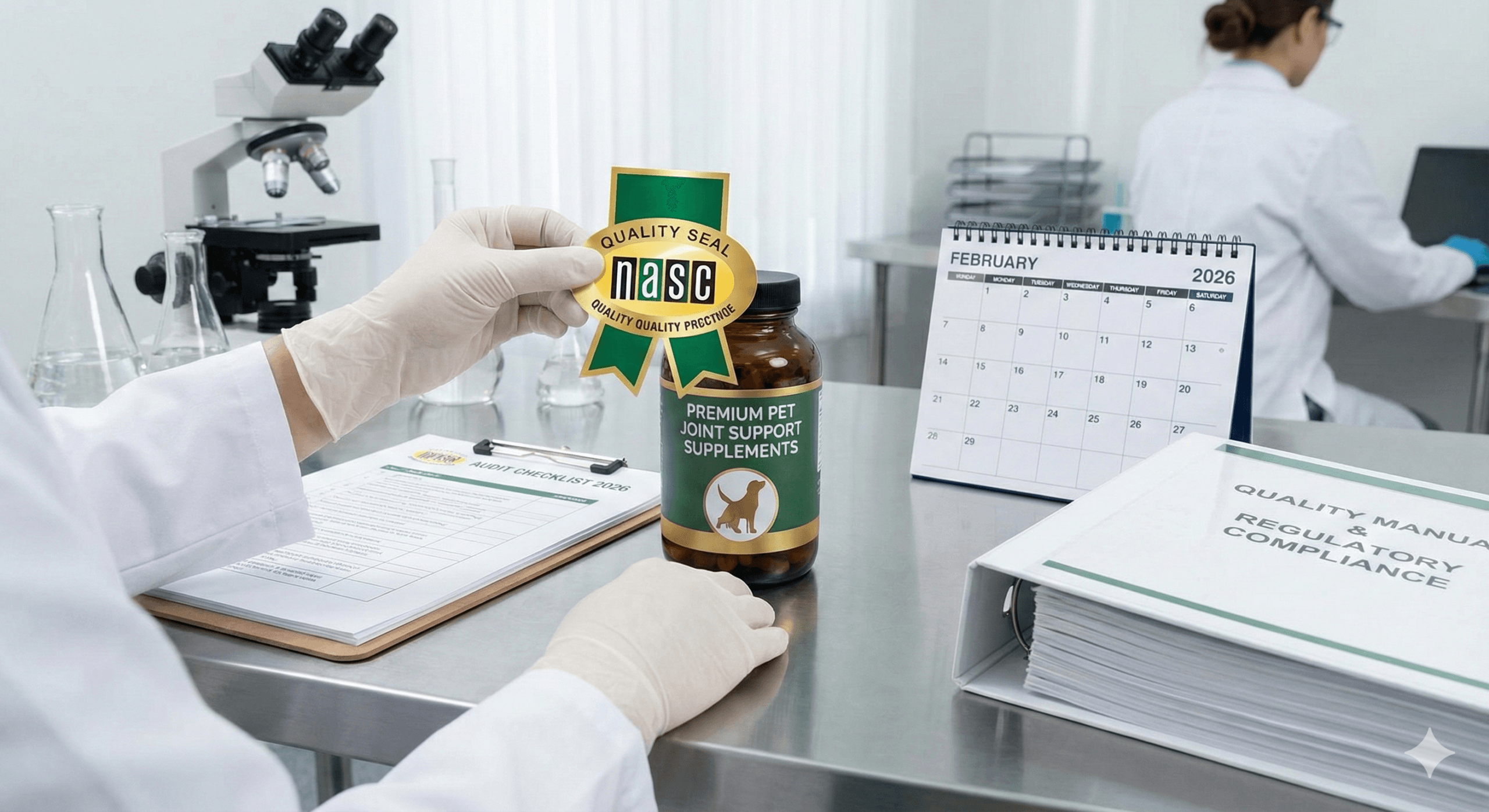
NASC certification has become the single most recognized quality credential in the pet supplement industry. With the global pet supplements market projected to reach $3.14 billion in 2026, competition for consumer trust has never been higher. The NASC Quality Seal signals that your supplements meet rigorous safety, labeling, and manufacturing standards.Earning it, however, takes preparation.
From building a compliant quality control system to passing an independent facility audit, the process demands attention to detail at every stage. This guide walks through each step so your brand can approach certification with clarity and confidence. Working with an experienced pet supplement manufacturer from the start may streamline much of this process, since production infrastructure plays a direct role in audit outcomes.
The Bottom Line: What Is the NASC Quality Seal?
The NASC Quality Seal is the pet supplement industry’s most widely recognized mark of product quality and safety. Issued by the National Animal Supplement Council, a nonprofit trade organization founded in 2001, it tells consumers and retailers that a brand has passed a comprehensive third-party audit and maintains ongoing NASC compliance with strict manufacturing and labeling standards.
To earn the seal, a company must implement documented standard operating procedures (SOPs), maintain an adverse event reporting system, follow FDA Center for Veterinary Medicine (FDA-CVM) labeling guidelines, and submit to random independent product testing. Products carrying the NASC Quality Seal are sold across veterinary offices, pet specialty retailers, and online channels.
| Requirement | What It Involves |
| Quality Control Manual | Written SOPs covering every stage of production |
| Adverse Event Reporting | Real-time system for tracking and reporting product complaints |
| Label Compliance | Adherence to NASC and FDA-CVM labeling formats and claims guidance |
| Third-Party Audit | Independent onsite facility audit every two years |
| Random Product Testing | Independent lab testing to verify products meet label claims |
| Annual Training | Mandatory continuing education facilitated by NASC |
Step-by-Step: The NASC Certification Process for Brands
The path to earning the NASC Quality Seal follows a structured sequence. Each step builds on the previous one, so brands that tackle them in order tend to move through the process more efficiently. Whether you manufacture in-house or work with a contract manufacturer, your company (as the “Supplier of Record”) is responsible for meeting every requirement below.
1. Join NASC as a Primary Supplier
Primary Supplier membership is the required starting point for any brand that markets finished pet supplements directly to consumers. This is different from the Preferred Supplier tier, which applies to raw material providers, contract manufacturers, and testing labs. Your application will require basic company information, product details, and a commitment to meet NASC quality standards. Membership is voluntary, and the organization currently includes nearly 300 member companies.
2. Develop a Quality Control Manual
Your quality control manual serves as the operational backbone of NASC compliance. It must contain written SOPs for every process your company controls, from ingredient receiving and storage to blending, packaging, and shipping. If you use a contract manufacturer, the manual also needs to document how you verify the processes your production partner performs on your behalf. Auditors will review this document closely.
3. Build an Adverse Event Reporting System
NASC requires every member to maintain an active system for monitoring and evaluating product complaints and adverse reactions. This system must track reports in real time using the NASC Adverse Event Reporting System (NAERS) database. Monthly reporting is mandatory, and early identification of potential ingredient or formulation issues may help protect both animals and your brand’s reputation.
4. Confirm Label Compliance
Labeling is one of the most scrutinized areas during the NASC audit. Every product label must follow NASC formatting and claims guidance, accurately represent ingredients and intended use, and include any caution or warning statements recommended by the FDA-CVM and the NASC Scientific Advisory Committee.
It is worth noting that the FDA does not recognize a “dietary supplement” classification for animal products, meaning pet supplements are regulated as either food or drugs depending on their intended use. Claims must align with the product’s intended function without crossing into unapproved territory. This is where many first-time applicants run into issues.
5. Pass the Independent Third-Party Audit
The final step is a comprehensive onsite facility audit conducted by an independent third party. This audit evaluates your facility, SOPs, label claims, and quality control manual against NASC standards. If auditors identify non-conformances, your company receives a detailed summary and has 60 days to submit corrective actions. Once all requirements are satisfied, NASC issues the audit certificate. The audit is valid for two years, and the full process repeats at each renewal cycle.
The NASC Quality Seal Audit Checklist
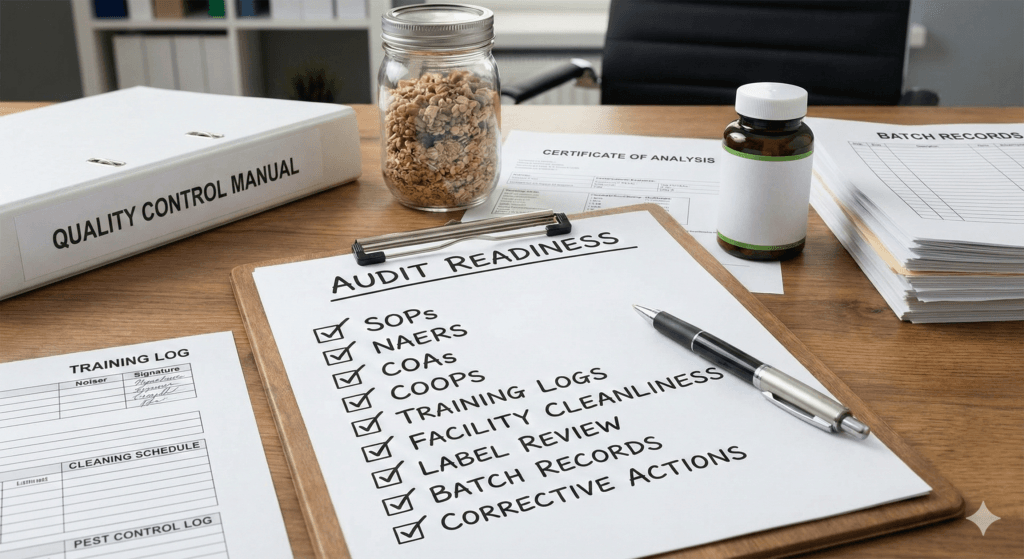
Preparation makes the difference between a smooth audit and a costly delay. Brands that arrive at audit day with organized documentation and consistent processes are far more likely to pass on the first attempt. Use this checklist to assess your readiness before scheduling your audit:
- Completed quality control manual with written SOPs for all controlled processes
- Active NAERS enrollment with up-to-date monthly reporting
- Third-party certificates of analysis (COAs) for all raw ingredients, verifying identity, purity, and potency
- Employee training logs showing staff competency in GMP procedures
- Clean facility verification with documented sanitation schedules and pest control records
- Accurate product labels reviewed against NASC and FDA-CVM formatting requirements
- Batch and lot traceability records from raw material receipt through finished product
- Documented corrective action procedures for handling deviations
Some brands pursuing NASC approved dog supplements and other pet products choose to work with facilities that already operate at the highest safety tiers available. Partnering with a human grade pet supplement manufacturing facility, for example, may simplify audit preparation since these operations already maintain strict hygiene standards, full batch traceability, documented sanitation procedures, and third-party testing protocols that align closely with NASC expectations.
How Long Does It Take to Get NASC Certified?
The NASC certification process typically takes approximately four months from membership application to Quality Seal approval, assuming your brand has its documentation and systems in place. That timeline can stretch considerably for companies that need to build their quality infrastructure from scratch. Developing a thorough quality control manual alone can take weeks if your SOPs have not been formally documented before.
The two-year audit renewal cycle also means this is not a one-time effort. Brands must maintain continuous compliance, participate in annual NASC training, and pass random product testing between audit cycles. Planning for ongoing resource allocation is just as important as the initial push to get NASC certified.
Why Partnering with an NASC-Compliant Manufacturer Is the Ultimate Shortcut
Navigating NASC guidelines independently requires significant time and infrastructure investment. For many emerging and mid-size pet supplement brands, the most efficient path to certification is working with a contract manufacturer that already operates within NASC-aligned quality systems.
What the Right Manufacturing Partner Provides
A qualified manufacturing partner brings audit-ready facilities, established SOPs, ingredient traceability systems, and third-party testing protocols that are already built to meet NASC standards. This means your brand can focus on product development and market growth rather than building compliance infrastructure from the ground up. The right partner also provides guidance on label compliance and claims language, which potentially reduces the risk of audit delays caused by labeling errors.
Partnering with PRONTO ensures your formulas and production methods are designed to meet the standards auditors evaluate. From ingredient sourcing and batch documentation to facility cleanliness and testing protocols, every element of the manufacturing process supports your path toward the Quality Seal.
Ready to get started? Partner with our expert pet supplement manufacturing team and take the most direct route to NASC certification for your brand.
Conclusion
Earning the NASC Quality Seal positions your pet supplement brand as a trusted name in an increasingly competitive market. The process demands thorough preparation across documentation, labeling, manufacturing protocols, and ongoing compliance, but the credibility it delivers to retailers and pet owners may be well worth the investment. An experienced, NASC-compliant manufacturing partner can simplify every stage.
It means the brand has passed an independent third-party audit and maintains ongoing compliance with NASC quality, labeling, and adverse event reporting standards.
NASC does not publicly list fees. Costs include membership dues, audit expenses, and any facility or process upgrades needed to meet standards.
No. NASC membership is voluntary. However, many retailers and consumers actively look for the Quality Seal when choosing products.
Primary Suppliers market finished supplements to consumers. Preferred Suppliers provide raw materials, manufacturing services, or lab testing to the industry.
References
Pet Supplements Market Size, Share & Growth | Trends [2034]. (2026). https://www.fortunebusinessinsights.com/pet-supplements-market-109797
National Animal Supplement Council.. About NASC.https://www.nasc.cc/about/
National Animal Supplement Council.. NASC Quality Seal. Retrieved from https://www.nasc.cc/nasc-seal/
U.S. Food and Drug Administration. Animal foods & feeds. Center for Veterinary Medicine. https://www.fda.gov/animal-veterinary/products/animal-foods-feeds
COMMONLY ASKED QUESTIONS



Advertisement. This site offers health, wellness, fitness and nutritional information and is designed for educational purposes only. You should not rely on this information as a substitute for, nor does it replace, professional medical advice, diagnosis, or treatment. If you have any concerns or questions about your health, you should always consult with a physician or other health-care professional. Do not disregard, avoid or delay obtaining medical or health related advice from your health-care professional because of something you may have read on this site. The use of any information provided on this site is solely at your own risk.